Start with your data
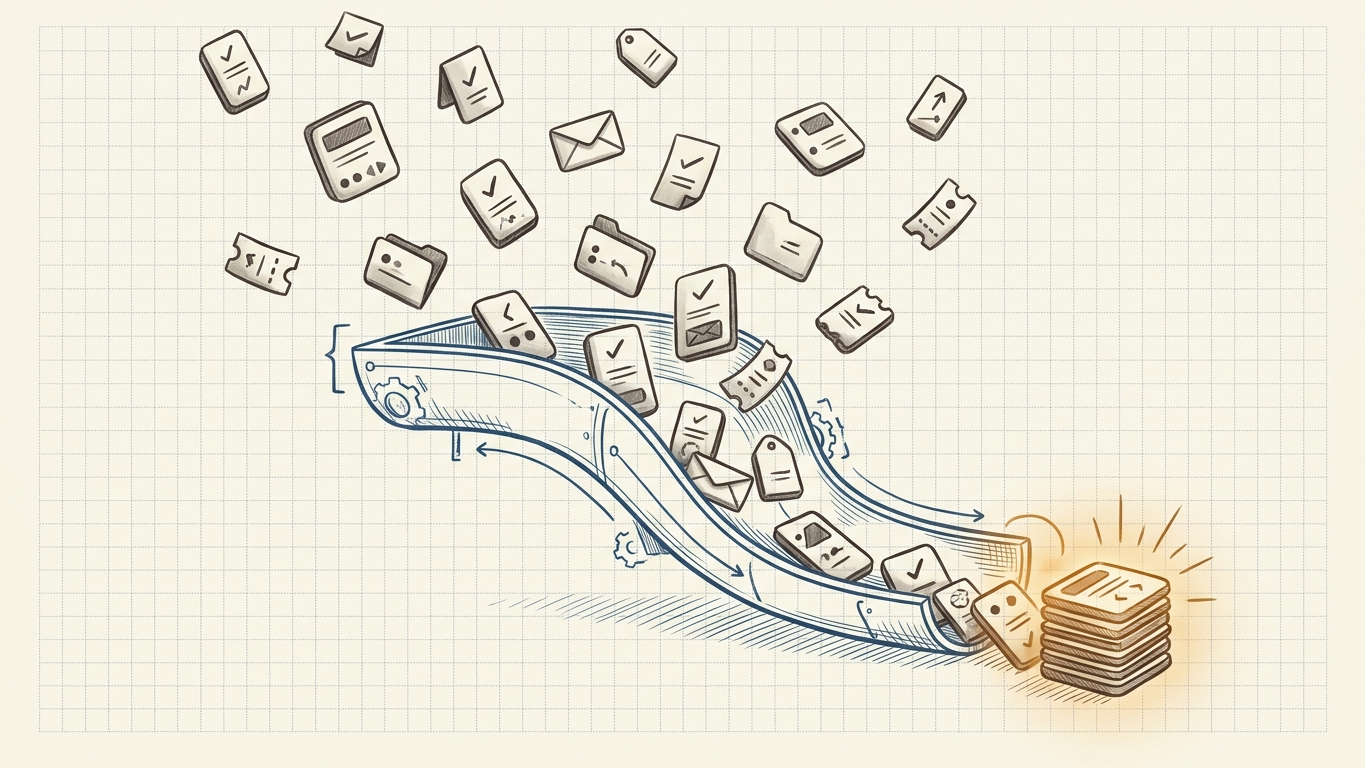
By the time we got around to auditing the memory system behind our AI — the database of facts, corrections, and hard-won lessons it's supposed to consult before doing anything — it held more than twelve thousand entries. Then we checked how many of those it could actually find when it needed them. Twenty-three percent. The other seventy-seven percent of everything we had taught the system was sitting right there in the database, technically present and functionally invisible, like a filing cabinet where somebody threw away all the folder tabs.
The cause was mundane. Searching by meaning requires an embedding — a numerical fingerprint of what each entry is about — and somewhere in the rush of building, the step that generates those fingerprints had quietly stopped keeping up. The system never complained. It never crashed. It just answered every question using a quarter of what it knew, with total confidence, for months.
That's the chapter, really. Everything below is elaboration. Every AI pitch you'll ever sit through starts at the demo — the chatbot, the agent, the magic. Nobody opens with data, because data is not magic. But AI sitting on top of messy data isn't intelligence. It's expensive noise.
The most expensive noise you can buy
Here is what an AI system actually does: it reads whatever data it can reach and produces confident output from it. That's the whole trick. Feed it clean records and you get leverage. Feed it a mess and you get something worse than nothing — fluent, plausible, wrong answers, billed by the word.
A human bookkeeper who hits a transaction that makes no sense will stop and ask somebody. An AI, unless you've specifically taught it to stop (that's Chapter 1.4 — Governance before capability), will file it somewhere reasonable-looking and move on. It doesn't know it's wrong. It can't. The records were its whole world, and the records lied.
We learned this on our own monitoring before we learned it anywhere else. Our health dashboard reported, in soothing green, that 64 of 64 background jobs were healthy. Then we read the raw logs: in one three-hour window, a whole job had silently failed to start, six errors had gone uncaught, and a single broken component had failed two thousand one hundred and eighty-five times. The dashboard knew about none of it, because it could only see the narrow slice of the system it had been pointed at — and it reported on that slice as if it were the whole picture. A green light bolted on top of a red one is worse than no light at all, because it actively tells you to stop looking.
Months of running this way taught us a rule I'd tattoo somewhere prominent if I were the tattoo type: when you move fast, the first thing to rot is the part of the system that's supposed to tell you the truth. Your data is that part. All of it.
What "clean enough" looks like for a contractor
The good news: clean enough is not perfection. You do not need a data warehouse or a consultant with a lanyard. Using the accounting books as the example — because money is where bad data hurts first — clean enough comes down to five conditions. This is, not coincidentally, the exact standard we had to write down before our AI bookkeeper was allowed anywhere near a bank statement.
Every dollar knows its job. Each project gets its own cost center — an accounting label that routes every transaction to the job it belongs to. Anything that genuinely belongs to no job is explicitly tagged overhead. No orphan dollars drifting around the ledger waiting to be adopted.
Every transaction answers three questions. Which project? What kind of transaction — a loan draw, a materials purchase, an insurance bill? And is it capitalized or expensed — meaning, does it get added to what the property cost you, or does it count against this month's profit? Get any of those wrong and either your profit statement or your balance sheet is fiction. Answer all three, every time, and a machine can follow the same trail you can.
Names are consistent. A vendor dictionary sounds bureaucratic and takes an afternoon: the lumberyard charge maps to the same materials cost code every single time, the framing sub maps to framing, and nobody ever has to interpret. What a bookkeeper calls judgment is often just remembering what you did last time. Write it down once and both the humans and the machine stop improvising.
Unknowns get flagged, not guessed. Anything that can't be classified confidently goes into a needs-review queue for a human. This one matters more with AI, not less — a wrong entry sitting visibly in a queue costs you a minute; a wrong entry filed confidently costs you a forensic accounting exercise in March.
It reads in plain English. Every entry gets a one-line remark saying what it was and why: which job, which vendor, what for. The test is brutally simple — if you can't write the sentence, the entry isn't done.
Notice that none of this is an AI standard. It's the standard any good bookkeeper always wanted from you. AI just raises the stakes: a human processes dozens of transactions a day and a machine processes thousands, so whatever your error rate is, automation compounds it at machine speed.
Clean is a habit, not a milestone
The seventy-seven-percent story has a happy ending — carefully. We took a verified snapshot first, because unlike code, twelve thousand learned lessons can't be regenerated if the repair goes sideways. Then we backfilled the missing fingerprints in small batches and checked the result. Coverage went from 23 percent to 100.
But the real lesson wasn't the fix. It was that we'd assumed "we set it up correctly once" meant "it's still correct," and data does not work that way. Data rots quietly, the way a backup you've never actually restored rots — and we'd learned that one too, the same season, when we discovered our nightly accounting backups had run faithfully for months without anyone once proving they could be restored. A backup you've never restored is not a backup; it's a hope with a timestamp. Records you never query are the same thing.
So here's the test I'd give any contractor before they spend a dollar on AI. Write down three questions you'd love to hand an assistant tomorrow: What have we spent on materials on that job this year? Which invoices haven't been paid? What's our real cash position across every account? Now try to answer them from your current records. If the records can answer them — slowly, painfully, but truthfully — AI will make you dramatically faster. If they can't, AI will simply be faster at being unable, and it will charge you for the privilege.
The genuinely good news is that this is builder work. Cleaning data is punch-list work: unglamorous, methodical, done to a written standard, inspected when finished. You already know how to do this. You've just been doing it to houses instead of ledgers. Chapter 4.2 — Phase 0: clean the data, name the sources of truth lays out the step-by-step; the next chapter covers the naming.
The Field Notes newsletter
Get HPC in your inbox
Notes from a builder running a homebuilding company on AI — attainable housing, construction ops, and the systems behind them. No spam, unsubscribe anytime.