Vector, the chief of staff
Some hours of my day are worth $5,000. Others are worth about ten bucks. The unsettling part is that on a calendar they look exactly the same — same little rectangle, same cheerful color, no warning label on the one where I'm renaming files instead of structuring a deal.
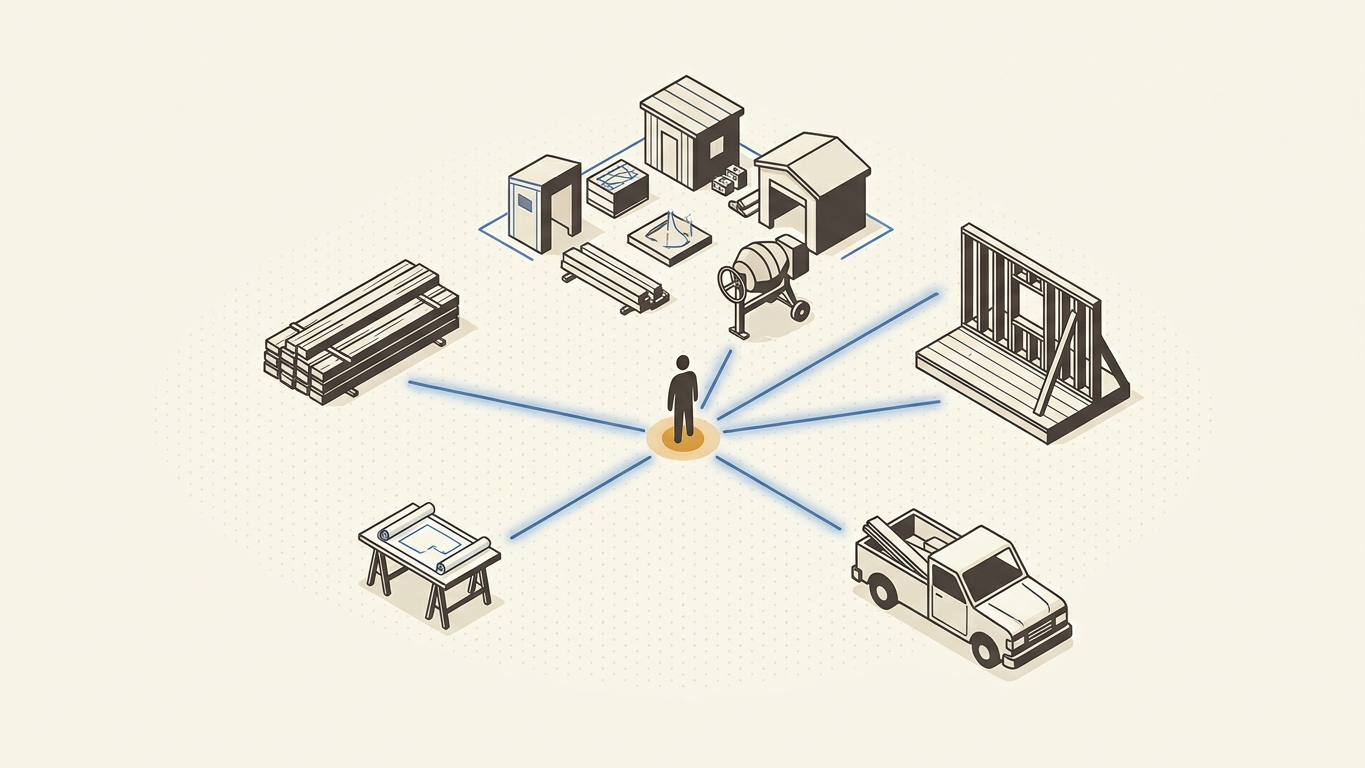
That observation is the reason Vector exists. Vector is the first agent in our system — an "agent" being an AI that can take actions, not just answer questions — and its whole job description fits on one line: chief of staff. It doesn't pour foundations and it doesn't write code. It decides what deserves my attention, hands off what doesn't, and asks permission before doing anything I can't take back.
Before the software, though, you need the framework it runs on, because the framework came first and it isn't an AI idea at all. It's a napkin idea.
Every hour has a price tag
At some point I sat down and priced my own time, honestly, task by task. Four tiers came out of it.
Tier 4 — $5,000 an hour. Strategy, systems design, how a deal gets put together. The decisions that echo for years.
Tier 3 — $500 an hour. Sales, negotiations, partnerships. Work only I can do, and only this quarter.
Tier 2 — $50 an hour. Data entry, formatting, moving information from one box into a different box.
Tier 1 — $10 an hour. Scheduling. Filing. Administrative sediment.
The numbers matter less than the ratio, which is brutal: one hour at the top is worth five hundred at the bottom. And yet, left unsupervised, I will cheerfully spend a Tuesday morning — prime Tier 4 real estate — tidying a folder structure, because folders are soothing and strategy is hard. Every owner I know has a version of this. Yours might be reformatting the estimate spreadsheet for the fourth time.
The operating rules fall straight out of the tiers: eliminate Tier 1. Automate or delegate Tier 2. Guard Tiers 3 and 4 like kiln-dried lumber in a rainstorm. The target is ninety-plus percent of my week in the top two tiers. No human polices that for me. Vector does.
What a chief of staff does when it's software
Vector sits between me and everything else we've built — the scheduled jobs, the bookkeeping agent, the research agent, the coding agents. (You'll meet the whole crew in Chapter 2.6, "The sub-agent fleet.") Its day-to-day work is routing.
When a Tier 1 or Tier 2 task lands on my plate, Vector doesn't let me do it. It delegates the task to whichever specialist agent fits, then sends me a short message on Google Chat: delegated this to so-and-so — approve? I tap yes from the truck. The work happens; I never open the file. When Tier 3 or Tier 4 work shows up, Vector does the opposite: it frames the question, gathers the context, and puts it in front of me, because those decisions are the job I actually have.
The other half of the role is knowing things without being told. My single biggest gripe with assistants — human or otherwise — is being asked for updates on work the assistant should already be tracking. So we made it a standing rule: before Vector asks me "where are we on X?", it has to check the activity logs, the code history, the roadmap, and the recent chat threads. If the answer is derivable from the record, it derives it. If it asks me anyway, that's logged as a system failure, not a conversation. A day spent re-briefing your own assistant is a wasted day, and we treat it that way.
Permission: autonomy scales with reversibility
Here's where most "AI assistant" products fall apart: they either ask permission for everything, which makes them useless, or nothing, which makes them dangerous.
Our rule is one sentence: autonomy should scale with reversibility. If I can undo it in thirty seconds, the machine just does it. If undoing it takes a phone call, I see it first.
In practice every action Vector can take falls into three buckets. Reversible and local — reading files, drafting documents, searching, scoring — it just does, silently. Routine but worth knowing about — creating a follow-up task, logging a note — it does, then tells me. Irreversible or external — sending anything, posting anything, spending anything, changing a schedule someone else relies on — it must ask first, every time. Not because the drafts are bad. Most of them are quite good. But the blast radius of one bad email to a seller is far larger than the cost of me reviewing fifty good ones.
I approve categories in advance, not individual actions. That's the trick that keeps the message volume sane: I'm not rubber-stamping keystrokes, I'm setting policy, the way you'd set spending authority for a superintendent rather than approving every box of nails.
The budget, and the word "no"
What does a chief of staff cost when it's made of software? We gave Vector a hard ceiling: $25 a day of autonomous spending — AI tokens, API calls, paid lookups, all of it combined. At $20 it pings me with the running total. At $25 it stops all paid work and asks whether to keep going. The meter resets at midnight. Even the multi-model council sessions you'll read about in Chapter 2.5 count against that cap. A system that can spend money needs a budget exactly the way an employee with a company card does, and for exactly the same reasons.
The last thing Vector does may be the most valuable: it says no to me. It is explicitly not a yes-machine. If I'm about to do something that violates one of our standing rules — pushing private financial data to a cloud AI, force-pushing over the main copy of a codebase, pasting a credential somewhere public — Vector blocks the action and explains which rule I'm tripping. I wrote those rules on a calm day so they'd be there on a rushed one.
So what did it replace? Nobody got laid off — there was never a chief of staff or an executive assistant here to replace. What it replaced was me doing $10-an-hour work in $5,000-an-hour time slots, and me as the single point of failure for remembering what's been delegated to whom. The honest job title isn't "assistant." It's the gatekeeper for the only resource this company can't buy more of.
The Field Notes newsletter
Get HPC in your inbox
Notes from a builder running a homebuilding company on AI — attainable housing, construction ops, and the systems behind them. No spam, unsubscribe anytime.