How We Used AI to Build 5 New Lines of Revenue
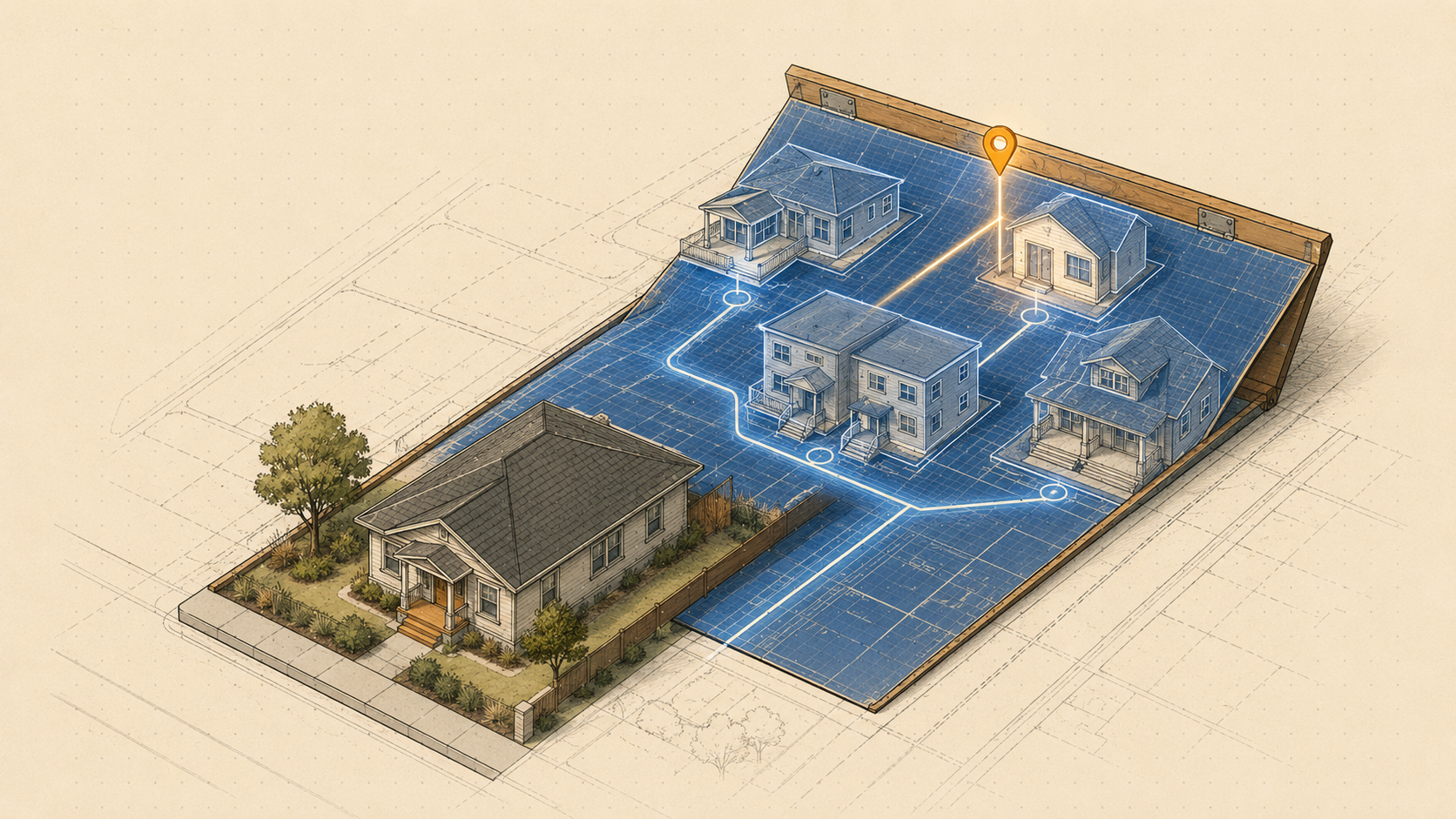
This week we are continuing to share the details on what it looks like to incorporate AI to do new things we can do now — things we couldn't do before — and how that changes our operations.
With the changes in California laws allowing for greater building density and fewer NIMBYs in our region, we have realized there is a lot of untapped potential — or "sleeping equity" — that many homeowners are unaware of. Our purpose as a homebuilder is to "Help Get More People into Homes."
The first attempt: Real Deal
Our first foray into building with AI started with building out a tool that took MLS data and would automatically analyze and create four proformas for four different micro-development pathways: flip, addition, ADU, or scrape.
It involved a lot of copy and paste, and I would meet online remotely with a young developer from overseas who would coach me through the process. I didn't know how to code. I didn't need to. That took me through much of 2025.
The project was dubbed Real Deal (short for Real Estate Deals), and it quickly identified for me that the majority of properties on the MLS have been priced in a way that the upside for flipping or micro-developing is pretty much gone. We would find a nugget of value every now and then, but it did not justify the work in maintaining the product — especially when you factor in the cost of working with MLS API data.
The project was shelved, and I moved on to hone my skills creating many other things, evolving alongside the coding tools as they came out.
Then came the XPRIZE
Then along came Peter Diamandis and the XPRIZE, co-sponsored by Google, offering $2,000,000 in prizes to build with Gemini and ship products that impact the world.
This led us to re-evaluate what we had built and see if we could do what our initial plans were, but lacked the expertise for. The goal was to review all residential properties in California for potential micro-development opportunities and understand them without the MLS involved — to review and find out what their Highest and Best Use would be. HABU.
What we asked ourselves along the way
Motivated with fresh impetus, and working with new coding tools, here are the things that we started to ask ourselves and try out along the way.
Could we:
1. Research the problem in a way that is faster and more thorough than ever before? Find articles on what work has been done in this area and see if others have addressed this pain point? That went quick.
2. Find publicly available data and APIs and analyze them to see if they would fit into our model? Could we pull in enough data through publicly available APIs without having to pay a third party? Would there be enough data? Would there be any gaps? The answer was yes; we could, no gaps.
3. Develop an outline spec and architecture for a web-based app to work with a cloud-based database, to be able to access the information we needed from anywhere? (Note: I am nowhere close to an architect — building or software.) Yes again.
4. Develop a set of algorithms (cloud functions) that would crunch the numbers the way we would, consistently and repeatedly in-house, without getting creative along the way? Uh-huh.
5. Develop a series of tests to validate that everything we would build would work? Yup.
6. Spin up a website, landing page, automated property lookup tool, generate a report on the findings, and be able to collect payment — in an afternoon? Check.
7. Find building codes in different cities, ingest them, analyze them, and translate them into numbers that work in our model? Did it.
8. Develop our own After Repair Value (ARV) and Automated Valuation Method (AVM) that calculates the current value and the future improvement values based on information that is available online? Our own AVM. Blew my mind. Sure did.
9. Develop a way to continually refine and fine-tune the AVM and ARV so that they are calibrated off of live current results for building costs and sales data? Blew my mind again. For real.
10. Add options, configurations, and paths that we had not modeled for originally, including more granular options for off-the-shelf (pre-approved) plans for ADUs? Didn't think that would happen, but it did.
11. Deliver a report that nails all the details every time? No way. It still needs a human in the loop for a review before underwriting. It still needs a site walk. It still needs proper underwriting. We did expect this one.
What came out of it
In the end, we were able to develop a simple tool that allows a homeowner to understand what development opportunities their lot actually holds. Even as an experienced developer, I am still learning new ways we can untap value for ourselves and other homeowners based on what the new laws allow.
From a business perspective, we were able to offer three paths to homeowners, one to real estate professionals, and a pay-per-report option — five new lines of revenue for ourselves:
A. Hire Nimble Development as a construction manager for a fee.
B. Hire Nimble to design-build the project.
C. Sell the property to Nimble directly and take the headache off your hands. You have the report of the market value for Highest and Best Use.
D. Work from our white-label list. We have a white-label list of all of the properties in our region that we have made available to real estate professionals and finance pros, for a fee, who are able to build off of this report and represent themselves as a leader and expert in this niche market. They market themselves to the people with the hidden value in their land.
E. The homeowner single-property report — a pay-per-report option that brings in some revenue to offset the marketing costs.
We have created a new product that creates awareness for owners in a way that hasn't been done before. It delivers a structured, consistent evaluation of a property that can be acted on to unlock wealth and provide more housing options.
In the end, we believe we have created a win-win-win scenario for property owners, Nimble Development, and real estate agents and financing pros — all in alignment with our mission of getting more people into homes.
Check it out at GetRealDeal.ai. It is currently an early version serving the Sacramento region only at this time. More coverage to follow.
The Field Notes newsletter
Get HPC in your inbox
Notes from a builder running a homebuilding company on AI — attainable housing, construction ops, and the systems behind them. No spam, unsubscribe anytime.